-35% SUR TOUS NOS TABLEAUXLIVRAISON OFFERTE DÈS 59€FABRIQUÉ EN EUROPE-35% SUR TOUS NOS TABLEAUXLIVRAISON OFFERTE DÈS 59€FABRIQUÉ EN EUROPE-35% SUR TOUS NOS TABLEAUXLIVRAISON OFFERTE DÈS 59€FABRIQUÉ EN EUROPE-35% SUR TOUS NOS TABLEAUXLIVRAISON OFFERTE DÈS 59€FABRIQUÉ EN EUROPE-35% SUR TOUS NOS TABLEAUXLIVRAISON OFFERTE DÈS 59€FABRIQUÉ EN EUROPE-35% SUR TOUS NOS TABLEAUXLIVRAISON OFFERTE DÈS 59€FABRIQUÉ EN EUROPE
35% OFF ALL OUR PAINTINGSFREE DELIVERY OVER £59MADE IN EUROPE35% OFF ALL OUR PAINTINGSFREE DELIVERY OVER £59MADE IN EUROPE35% OFF ALL OUR PAINTINGSFREE DELIVERY OVER £59MADE IN EUROPE35% OFF ALL OUR PAINTINGSFREE DELIVERY OVER £59MADE IN EUROPE35% OFF ALL OUR PAINTINGSFREE DELIVERY OVER £59MADE IN EUROPE35% OFF ALL OUR PAINTINGSFREE DELIVERY OVER £59MADE IN EUROPE
35% DE DESCUENTO EN TODOS NUESTROS CUADROSENVÍO GRATIS A PARTIR DE 59€FABRICADO EN EUROPA35% DE DESCUENTO EN TODOS NUESTROS CUADROSENVÍO GRATIS A PARTIR DE 59€FABRICADO EN EUROPA35% DE DESCUENTO EN TODOS NUESTROS CUADROSENVÍO GRATIS A PARTIR DE 59€FABRICADO EN EUROPA35% DE DESCUENTO EN TODOS NUESTROS CUADROSENVÍO GRATIS A PARTIR DE 59€FABRICADO EN EUROPA35% DE DESCUENTO EN TODOS NUESTROS CUADROSENVÍO GRATIS A PARTIR DE 59€FABRICADO EN EUROPA35% DE DESCUENTO EN TODOS NUESTROS CUADROSENVÍO GRATIS A PARTIR DE 59€FABRICADO EN EUROPA
35% DI SCONTO SU TUTTI I NOSTRI QUADRISPEDIZIONE GRATUITA SOPRA I 59€PRODOTTO IN EUROPA35% DI SCONTO SU TUTTI I NOSTRI QUADRISPEDIZIONE GRATUITA SOPRA I 59€PRODOTTO IN EUROPA35% DI SCONTO SU TUTTI I NOSTRI QUADRISPEDIZIONE GRATUITA SOPRA I 59€PRODOTTO IN EUROPA35% DI SCONTO SU TUTTI I NOSTRI QUADRISPEDIZIONE GRATUITA SOPRA I 59€PRODOTTO IN EUROPA35% DI SCONTO SU TUTTI I NOSTRI QUADRISPEDIZIONE GRATUITA SOPRA I 59€PRODOTTO IN EUROPA35% DI SCONTO SU TUTTI I NOSTRI QUADRISPEDIZIONE GRATUITA SOPRA I 59€PRODOTTO IN EUROPA
35% RABATT AUF ALLE UNSERE BILDERKOSTENLOSER VERSAND AB 59€HERGESTELLT IN EUROPA35% RABATT AUF ALLE UNSERE BILDERKOSTENLOSER VERSAND AB 59€HERGESTELLT IN EUROPA35% RABATT AUF ALLE UNSERE BILDERKOSTENLOSER VERSAND AB 59€HERGESTELLT IN EUROPA35% RABATT AUF ALLE UNSERE BILDERKOSTENLOSER VERSAND AB 59€HERGESTELLT IN EUROPA35% RABATT AUF ALLE UNSERE BILDERKOSTENLOSER VERSAND AB 59€HERGESTELLT IN EUROPA35% RABATT AUF ALLE UNSERE BILDERKOSTENLOSER VERSAND AB 59€HERGESTELLT IN EUROPA
35% KORTING OP AL ONZE SCHILDERIJENGRATIS VERZENDING VANAF 59€GEMAAKT IN EUROPA35% KORTING OP AL ONZE SCHILDERIJENGRATIS VERZENDING VANAF 59€GEMAAKT IN EUROPA35% KORTING OP AL ONZE SCHILDERIJENGRATIS VERZENDING VANAF 59€GEMAAKT IN EUROPA35% KORTING OP AL ONZE SCHILDERIJENGRATIS VERZENDING VANAF 59€GEMAAKT IN EUROPA35% KORTING OP AL ONZE SCHILDERIJENGRATIS VERZENDING VANAF 59€GEMAAKT IN EUROPA35% KORTING OP AL ONZE SCHILDERIJENGRATIS VERZENDING VANAF 59€GEMAAKT IN EUROPA
-35% SUR TOUS NOS TABLEAUXLIVRAISON OFFERTE DÈS 59€FABRIQUÉ EN EUROPE-35% SUR TOUS NOS TABLEAUXLIVRAISON OFFERTE DÈS 59€FABRIQUÉ EN EUROPE-35% SUR TOUS NOS TABLEAUXLIVRAISON OFFERTE DÈS 59€FABRIQUÉ EN EUROPE-35% SUR TOUS NOS TABLEAUXLIVRAISON OFFERTE DÈS 59€FABRIQUÉ EN EUROPE-35% SUR TOUS NOS TABLEAUXLIVRAISON OFFERTE DÈS 59€FABRIQUÉ EN EUROPE-35% SUR TOUS NOS TABLEAUXLIVRAISON OFFERTE DÈS 59€FABRIQUÉ EN EUROPE
35% OFF ALL OUR PAINTINGSFREE DELIVERY OVER £59MADE IN EUROPE35% OFF ALL OUR PAINTINGSFREE DELIVERY OVER £59MADE IN EUROPE35% OFF ALL OUR PAINTINGSFREE DELIVERY OVER £59MADE IN EUROPE35% OFF ALL OUR PAINTINGSFREE DELIVERY OVER £59MADE IN EUROPE35% OFF ALL OUR PAINTINGSFREE DELIVERY OVER £59MADE IN EUROPE35% OFF ALL OUR PAINTINGSFREE DELIVERY OVER £59MADE IN EUROPE
35% DE DESCUENTO EN TODOS NUESTROS CUADROSENVÍO GRATIS A PARTIR DE 59€FABRICADO EN EUROPA35% DE DESCUENTO EN TODOS NUESTROS CUADROSENVÍO GRATIS A PARTIR DE 59€FABRICADO EN EUROPA35% DE DESCUENTO EN TODOS NUESTROS CUADROSENVÍO GRATIS A PARTIR DE 59€FABRICADO EN EUROPA35% DE DESCUENTO EN TODOS NUESTROS CUADROSENVÍO GRATIS A PARTIR DE 59€FABRICADO EN EUROPA35% DE DESCUENTO EN TODOS NUESTROS CUADROSENVÍO GRATIS A PARTIR DE 59€FABRICADO EN EUROPA35% DE DESCUENTO EN TODOS NUESTROS CUADROSENVÍO GRATIS A PARTIR DE 59€FABRICADO EN EUROPA
35% DI SCONTO SU TUTTI I NOSTRI QUADRISPEDIZIONE GRATUITA SOPRA I 59€PRODOTTO IN EUROPA35% DI SCONTO SU TUTTI I NOSTRI QUADRISPEDIZIONE GRATUITA SOPRA I 59€PRODOTTO IN EUROPA35% DI SCONTO SU TUTTI I NOSTRI QUADRISPEDIZIONE GRATUITA SOPRA I 59€PRODOTTO IN EUROPA35% DI SCONTO SU TUTTI I NOSTRI QUADRISPEDIZIONE GRATUITA SOPRA I 59€PRODOTTO IN EUROPA35% DI SCONTO SU TUTTI I NOSTRI QUADRISPEDIZIONE GRATUITA SOPRA I 59€PRODOTTO IN EUROPA35% DI SCONTO SU TUTTI I NOSTRI QUADRISPEDIZIONE GRATUITA SOPRA I 59€PRODOTTO IN EUROPA
35% RABATT AUF ALLE UNSERE BILDERKOSTENLOSER VERSAND AB 59€HERGESTELLT IN EUROPA35% RABATT AUF ALLE UNSERE BILDERKOSTENLOSER VERSAND AB 59€HERGESTELLT IN EUROPA35% RABATT AUF ALLE UNSERE BILDERKOSTENLOSER VERSAND AB 59€HERGESTELLT IN EUROPA35% RABATT AUF ALLE UNSERE BILDERKOSTENLOSER VERSAND AB 59€HERGESTELLT IN EUROPA35% RABATT AUF ALLE UNSERE BILDERKOSTENLOSER VERSAND AB 59€HERGESTELLT IN EUROPA35% RABATT AUF ALLE UNSERE BILDERKOSTENLOSER VERSAND AB 59€HERGESTELLT IN EUROPA
35% KORTING OP AL ONZE SCHILDERIJENGRATIS VERZENDING VANAF 59€GEMAAKT IN EUROPA35% KORTING OP AL ONZE SCHILDERIJENGRATIS VERZENDING VANAF 59€GEMAAKT IN EUROPA35% KORTING OP AL ONZE SCHILDERIJENGRATIS VERZENDING VANAF 59€GEMAAKT IN EUROPA35% KORTING OP AL ONZE SCHILDERIJENGRATIS VERZENDING VANAF 59€GEMAAKT IN EUROPA35% KORTING OP AL ONZE SCHILDERIJENGRATIS VERZENDING VANAF 59€GEMAAKT IN EUROPA35% KORTING OP AL ONZE SCHILDERIJENGRATIS VERZENDING VANAF 59€GEMAAKT IN EUROPA
Why High-Quality Wall Art is the Best Investment for Your Interior Design
4 October 2026 Laure D 9 min de lecture
Home decor purchases often follow a cycle: buy, tire, replace. Wall art breaks that cycle when chosen with the same rigor applied to furniture or flooring. A museum-grade canvas or a hand-finished aluminum panel does more than fill empty wall space, it establishes a visual anchor that survives trend shifts, moves with you across homes, and can even appreciate if the artist gains recognition. This article explains the tangible criteria that separate investment-grade wall art from decorative filler, so you can allocate budget where it yields the highest return per square foot.
High-quality wall art appreciates aesthetically and financially because it uses archival materials, resists fading, and anchors a room’s design for decades. Unlike mass-produced prints, investment-grade pieces maintain color accuracy and structural integrity, making them a durable asset rather than a disposable accessory.
What Makes Wall Art an Investment-Grade Asset
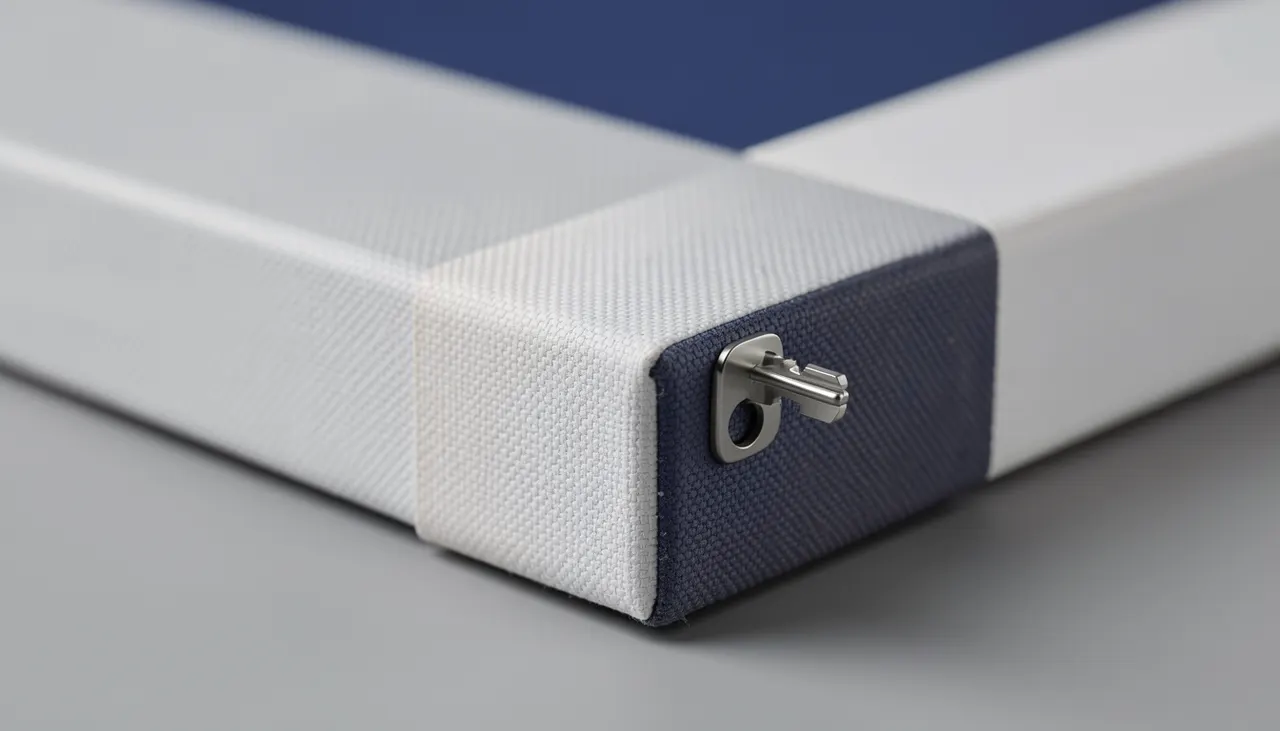
Investment-grade wall art shares three measurable attributes: material permanence, color stability, and structural integrity. Material permanence means the substrate, whether cotton canvas, aluminum composite, or archival paper, resists warping, yellowing, or embrittlement for 50 years under normal indoor conditions. Color stability relies on pigment-based inks rated for 100+ years under museum lighting (50 lux, UV-filtered) rather than dye-based inks that fade in months. Structural integrity covers the stretcher bars, frame joinery, and hanging hardware: kiln-dried wood that won’t twist, corner keys that allow re-tensioning, and D-rings rated for twice the artwork’s weight.
Mass-market posters printed on resin-coated paper with dye inks fail all three. They curl at the edges within a year, shift toward magenta as cyan fades first, and tear if removed from the wall. Investment pieces cost 5-10 times more upfront but eliminate replacement cycles. Over a 20-year horizon, a single $800 archival canvas costs less per year than four $150 posters replaced every five years, and the canvas retains resale value while posters do not.
The Role of Provenance and Edition Size
Provenance, documented ownership history, and limited edition numbers (typically 50-250 for fine art prints) create scarcity that drives secondary-market demand. Open editions have no ceiling; a print run of 10,000 ensures supply always exceeds demand. A certificate of authenticity signed by the artist or publisher, matching the edition number on the artwork, is the minimum documentation for any piece priced above $500. Without it, you own decor, not an asset.
Close-up of canvas texture showing pigment depth and stretcher bar corner
Durability and Material Quality Determine Long-Term Value
The substrate dictates lifespan. Cotton canvas (380-450 gsm) stretched over kiln-dried pine with cross-bracing resists sagging for decades. Aluminum composite panels (3 mm Dibond or Alu Dibond) offer rigid, moisture-proof support ideal for humid climates or large formats beyond 150 cm. Archival rag paper (100% cotton, 300 gsm) mounted on acid-free foam board behind UV-filtering acrylic glazing suits photographic and watercolor works. Each material has a distinct failure mode: canvas relaxes over time (fixable with keys), aluminum never moves but dents on impact, paper cockles if humidity exceeds 60% RH.
Ink technology is equally critical. Pigment inks (e.g., Epson UltraChrome Pro, Canon Lucia Pro) embed insoluble particles in a resin binder; they sit on top of the coating and resist ozone and light. Dye inks soak into the coating and bleed. A simple test: dampen a cotton swab with distilled water and touch an inconspicuous edge. Pigment won’t transfer; dye will. Reputable workshops provide ink certification sheets, ask for them before purchasing.
Environmental Factors You Can Control
Even archival materials degrade faster under poor conditions. Keep relative humidity between 40-55% and temperature 18-22°C. Avoid direct sunlight, UV radiation breaks chemical bonds in pigments and yellows varnishes. Use LED picture lights with CRI >90 and no UV emission if accent lighting is desired. Hang works on interior walls, not above radiators or in bathrooms. A $30 hygrometer near your most valuable piece pays for itself by preventing one costly restoration.
Trend-driven art, think of-the-moment color palettes or viral motifs, loses visual relevance in 3-5 years. Investment-grade work demonstrates compositional discipline: balanced weight, intentional negative space, a clear focal hierarchy, and a color relationship that follows established harmony principles (complementary, split-complementary, triadic). These principles are not subjective; they are rooted in perceptual psychology and have guided visual art for centuries.
Examine the artist’s track record: gallery representation, museum acquisitions, publication in peer-reviewed journals, consistent exhibition history over 10+ years. Emerging artists with MFA degrees from top programs and solo shows in respected commercial galleries carry lower risk than self-taught creators with only Instagram followings. Price history matters: ask for auction records or primary-market price progression. A steady 5-10% annual increase over a decade signals collector confidence; a single spike followed by flatline suggests speculation.
Color Palettes That Endure
Neutral-anchored palettes, warm grays, oxidized greens, earth reds, deep blues, integrate across design styles from mid-century to minimalist. High-chroma accent colors (cobalt, vermilion, emerald) work when confined to 10-15% of the surface area. The swatch grid below shows three timeless combinations used in museum acquisitions for the past 50 years.
Sizing and Placement for Maximum Visual Return
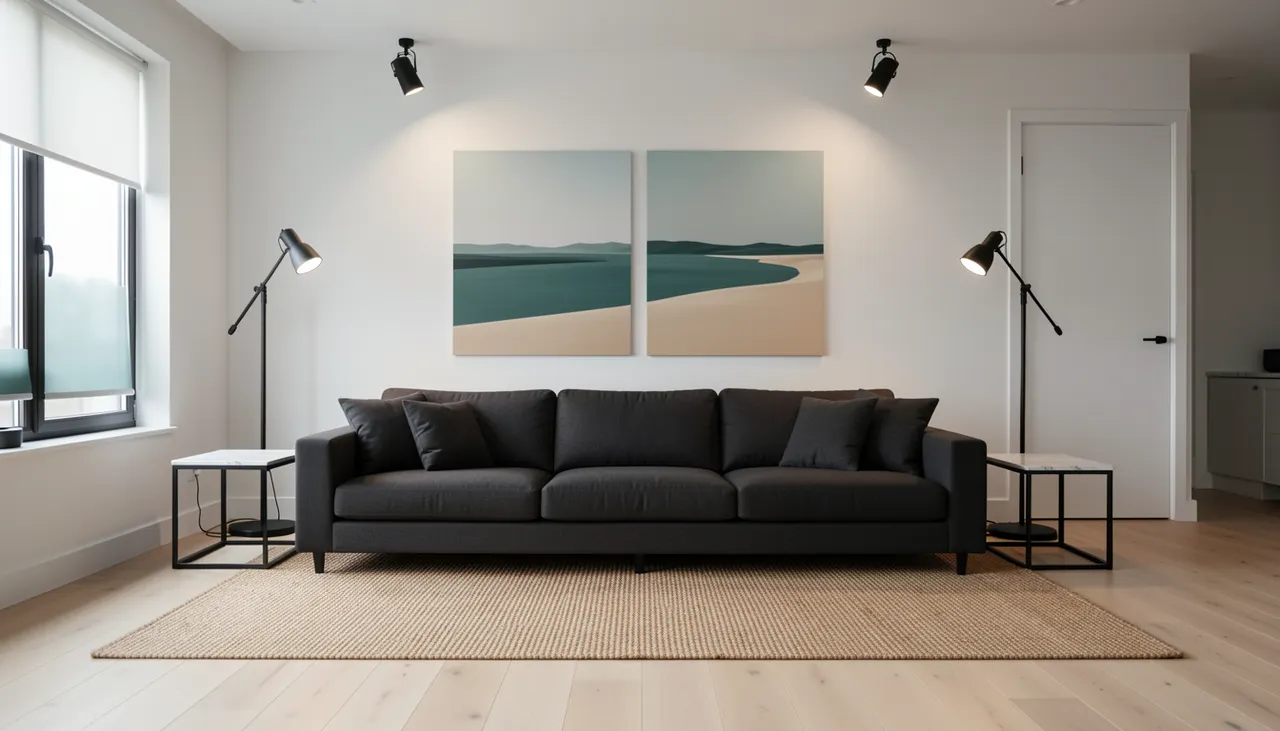
Scale is the single most common error. A 60×40 cm piece above a 240 cm sofa reads as a postage stamp. The artwork width should be 60-75% of the furniture width it anchors. For a 240 cm sofa, target 145-180 cm wide art (single large piece or a diptych with 5 cm gap). Height center aligns with eye level: 155-160 cm from floor to center for standing viewers, 130-135 cm for seated dining areas. Leave 15-25 cm between the top of the sofa back and the bottom of the frame.
Lighting multiplies perceived value. A 3000K LED track head at 30-degree angle, 2 meters away, delivers 200 lux on the surface, enough to reveal texture without glare. Avoid fluorescent or cool-white LEDs (4000K+) which distort warm pigments. If natural light hits the piece, install UV-filtering window film (blocks 99% UV, reduces visible light by 15%).
Grouping Strategies for Collections
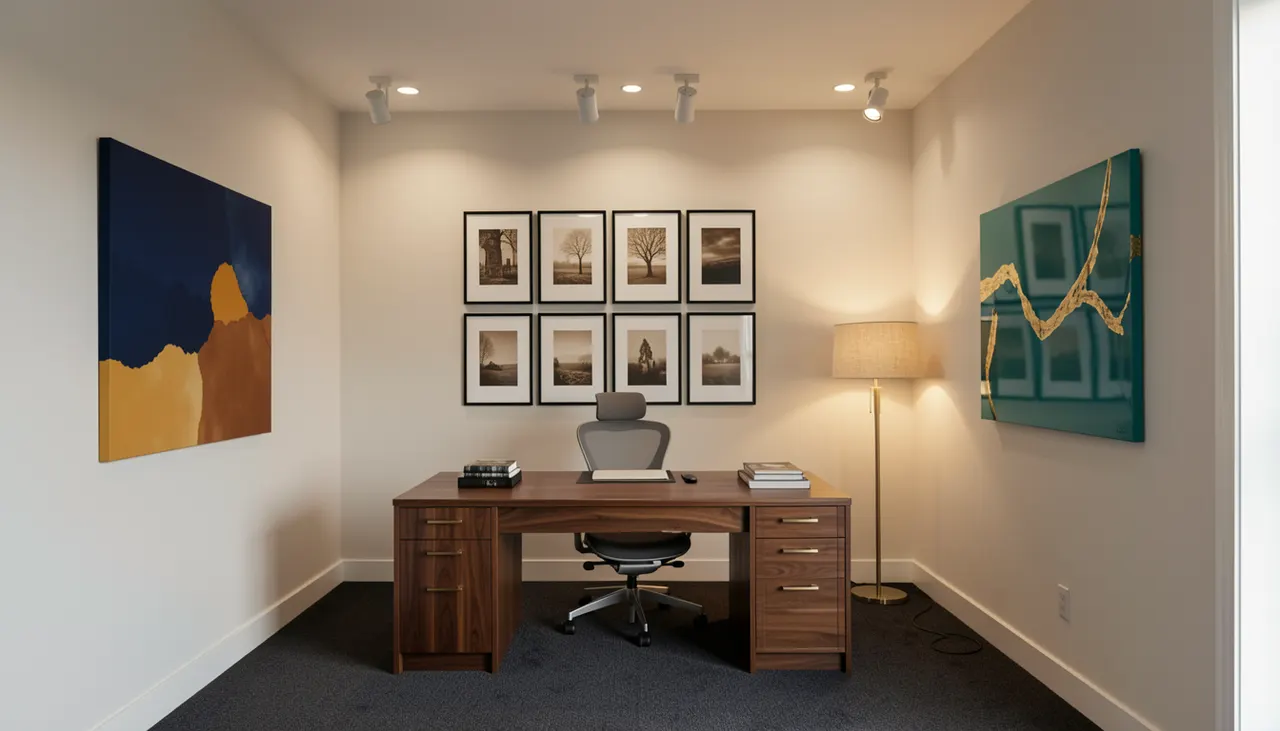
Gallery walls follow a grid or salon style. Grid: identical frames, 5 cm spacing, bottom edges aligned at 130 cm. Salon: mixed sizes, unified by a single color palette or theme, clustered within an imaginary rectangle 180 cm wide x 120 cm high. In both cases, the center of the composition sits at 155 cm. Use paper templates taped to the wall before drilling.
Living room with properly scaled diptych above sofa, track lighting
The finish protects the artwork and defines its presentation. Three premium options dominate the investment market: traditional stretched canvas, floating frame (caisse américaine), and aluminum brilliant (face-mounted to acrylic). Each suits different aesthetics and environments. The table below compares critical specifications.
Building a Cohesive Collection Over Time
A collection grows piece by piece, guided by a unifying thesis: a color family, a geographic region, a medium, or a conceptual theme. Start with one anchor work, the largest, most expensive piece, that sets the palette and scale for the room. Subsequent acquisitions should dialogue with it: share a dominant hue, repeat a formal motif, or contrast in a deliberate way (e.g., a minimalist abstract beside a detailed figurative work).
Budget allocation: spend 60% on the anchor, 30% on two supporting pieces, 10% on flexible smaller works (works on paper, small bronzes) that can move between rooms. Acquire one major piece per year rather than three minor ones. This pace allows research, builds relationships with galleries, and spreads cash flow. Track every purchase in a spreadsheet: artist, title, date, medium, dimensions, edition, price, seller, certificate number, insurance value, and high-resolution photographs front and back.
Insurance and Appraisal Updates
Standard homeowners policies cap art coverage at $1,500-$2,500 total. Schedule valuable pieces individually with a fine-art rider (typically 0.1-0.2% of insured value annually). Require a qualified appraisal every 3-5 years or after any major market event (artist retrospective, auction record). Appraisers should be accredited by ASA, AAA, or ISA, not the selling gallery. Keep digital copies of appraisals, certificates, and purchase receipts in cloud storage and a physical fireproof safe.
Home office with curated art collection on white walls
Frequently asked questions
How do I know if a wall art piece is truly archival quality?
Ask for the ink certification (pigment-based, not dye), substrate specifications (cotton canvas 380+ gsm, aluminum composite, or 100% cotton rag paper), and a certificate of authenticity with edition number. Reputable workshops provide all three.
What is the ideal height to hang artwork?
Center the artwork at 155-160 cm from the floor for standing view, or 130-135 cm for seated areas like dining rooms. Maintain 15-25 cm clearance above furniture backs.
Can I hang investment-grade art in a bathroom or kitchen?
Only aluminum composite panels with face-mounted acrylic withstand humidity swings. Canvas and paper will warp or mold. Even then, avoid direct steam contact and run exhaust fans.
How often should I re-appraise my art collection?
Every 3-5 years, or after a major market event for the artist (museum show, auction record). Use an accredited appraiser (ASA, AAA, ISA), not the selling gallery.
What lighting damages artwork the least?
LED lights with CRI >90, color temperature 2700-3000K, and zero UV emission. Keep illuminance under 200 lux for sensitive works; use UV-filtering window film on nearby glazing.
Treating wall art as an investment changes how you shop: you ask for ink certifications, you measure wall-to-furniture ratios, you budget for proper lighting and insurance. The result is a collection that elevates daily life, survives moves and trend cycles, and can be passed down or sold. Start with one anchor piece that meets every archival criterion, your future self will recognize the difference every time you walk into the room.
Key takeaways
Archival canvas, aluminum, and rag paper with pigment inks last 50-100 years; posters fade in months.
Artwork width should be 60-75% of the furniture width it anchors for correct visual scale.
Limited editions (50-250) with signed certificates hold resale value; open editions do not.
Control humidity (40-55%), temperature (18-22°C), and UV exposure to preserve value.
Insure valuable pieces with a fine-art rider and update appraisals every 3-5 years.
Partager sur :
Laure D
Passionate about interior design and architecture, Laure D. is the inspiring voice behind Museno. As a decor trends specialist, she elegantly decodes color harmonies, the art of detail, and space planning to transform every interior into a unique sanctuary. Through her articles and guides, Laure shares expert advice and inspiration to help you elevate your daily life, from contemporary minimalism to bolder aesthetics. Her mission: to bring life to your rooms and walls with inspiring, accessible ideas.