-35% SUR TOUS NOS TABLEAUXLIVRAISON OFFERTE DÈS 59€FABRIQUÉ EN EUROPE-35% SUR TOUS NOS TABLEAUXLIVRAISON OFFERTE DÈS 59€FABRIQUÉ EN EUROPE-35% SUR TOUS NOS TABLEAUXLIVRAISON OFFERTE DÈS 59€FABRIQUÉ EN EUROPE-35% SUR TOUS NOS TABLEAUXLIVRAISON OFFERTE DÈS 59€FABRIQUÉ EN EUROPE-35% SUR TOUS NOS TABLEAUXLIVRAISON OFFERTE DÈS 59€FABRIQUÉ EN EUROPE-35% SUR TOUS NOS TABLEAUXLIVRAISON OFFERTE DÈS 59€FABRIQUÉ EN EUROPE
35% OFF ALL OUR PAINTINGSFREE DELIVERY OVER £59MADE IN EUROPE35% OFF ALL OUR PAINTINGSFREE DELIVERY OVER £59MADE IN EUROPE35% OFF ALL OUR PAINTINGSFREE DELIVERY OVER £59MADE IN EUROPE35% OFF ALL OUR PAINTINGSFREE DELIVERY OVER £59MADE IN EUROPE35% OFF ALL OUR PAINTINGSFREE DELIVERY OVER £59MADE IN EUROPE35% OFF ALL OUR PAINTINGSFREE DELIVERY OVER £59MADE IN EUROPE
35% DE DESCUENTO EN TODOS NUESTROS CUADROSENVÍO GRATIS A PARTIR DE 59€FABRICADO EN EUROPA35% DE DESCUENTO EN TODOS NUESTROS CUADROSENVÍO GRATIS A PARTIR DE 59€FABRICADO EN EUROPA35% DE DESCUENTO EN TODOS NUESTROS CUADROSENVÍO GRATIS A PARTIR DE 59€FABRICADO EN EUROPA35% DE DESCUENTO EN TODOS NUESTROS CUADROSENVÍO GRATIS A PARTIR DE 59€FABRICADO EN EUROPA35% DE DESCUENTO EN TODOS NUESTROS CUADROSENVÍO GRATIS A PARTIR DE 59€FABRICADO EN EUROPA35% DE DESCUENTO EN TODOS NUESTROS CUADROSENVÍO GRATIS A PARTIR DE 59€FABRICADO EN EUROPA
35% DI SCONTO SU TUTTI I NOSTRI QUADRISPEDIZIONE GRATUITA SOPRA I 59€PRODOTTO IN EUROPA35% DI SCONTO SU TUTTI I NOSTRI QUADRISPEDIZIONE GRATUITA SOPRA I 59€PRODOTTO IN EUROPA35% DI SCONTO SU TUTTI I NOSTRI QUADRISPEDIZIONE GRATUITA SOPRA I 59€PRODOTTO IN EUROPA35% DI SCONTO SU TUTTI I NOSTRI QUADRISPEDIZIONE GRATUITA SOPRA I 59€PRODOTTO IN EUROPA35% DI SCONTO SU TUTTI I NOSTRI QUADRISPEDIZIONE GRATUITA SOPRA I 59€PRODOTTO IN EUROPA35% DI SCONTO SU TUTTI I NOSTRI QUADRISPEDIZIONE GRATUITA SOPRA I 59€PRODOTTO IN EUROPA
35% RABATT AUF ALLE UNSERE BILDERKOSTENLOSER VERSAND AB 59€HERGESTELLT IN EUROPA35% RABATT AUF ALLE UNSERE BILDERKOSTENLOSER VERSAND AB 59€HERGESTELLT IN EUROPA35% RABATT AUF ALLE UNSERE BILDERKOSTENLOSER VERSAND AB 59€HERGESTELLT IN EUROPA35% RABATT AUF ALLE UNSERE BILDERKOSTENLOSER VERSAND AB 59€HERGESTELLT IN EUROPA35% RABATT AUF ALLE UNSERE BILDERKOSTENLOSER VERSAND AB 59€HERGESTELLT IN EUROPA35% RABATT AUF ALLE UNSERE BILDERKOSTENLOSER VERSAND AB 59€HERGESTELLT IN EUROPA
35% KORTING OP AL ONZE SCHILDERIJENGRATIS VERZENDING VANAF 59€GEMAAKT IN EUROPA35% KORTING OP AL ONZE SCHILDERIJENGRATIS VERZENDING VANAF 59€GEMAAKT IN EUROPA35% KORTING OP AL ONZE SCHILDERIJENGRATIS VERZENDING VANAF 59€GEMAAKT IN EUROPA35% KORTING OP AL ONZE SCHILDERIJENGRATIS VERZENDING VANAF 59€GEMAAKT IN EUROPA35% KORTING OP AL ONZE SCHILDERIJENGRATIS VERZENDING VANAF 59€GEMAAKT IN EUROPA35% KORTING OP AL ONZE SCHILDERIJENGRATIS VERZENDING VANAF 59€GEMAAKT IN EUROPA
-35% SUR TOUS NOS TABLEAUXLIVRAISON OFFERTE DÈS 59€FABRIQUÉ EN EUROPE-35% SUR TOUS NOS TABLEAUXLIVRAISON OFFERTE DÈS 59€FABRIQUÉ EN EUROPE-35% SUR TOUS NOS TABLEAUXLIVRAISON OFFERTE DÈS 59€FABRIQUÉ EN EUROPE-35% SUR TOUS NOS TABLEAUXLIVRAISON OFFERTE DÈS 59€FABRIQUÉ EN EUROPE-35% SUR TOUS NOS TABLEAUXLIVRAISON OFFERTE DÈS 59€FABRIQUÉ EN EUROPE-35% SUR TOUS NOS TABLEAUXLIVRAISON OFFERTE DÈS 59€FABRIQUÉ EN EUROPE
35% OFF ALL OUR PAINTINGSFREE DELIVERY OVER £59MADE IN EUROPE35% OFF ALL OUR PAINTINGSFREE DELIVERY OVER £59MADE IN EUROPE35% OFF ALL OUR PAINTINGSFREE DELIVERY OVER £59MADE IN EUROPE35% OFF ALL OUR PAINTINGSFREE DELIVERY OVER £59MADE IN EUROPE35% OFF ALL OUR PAINTINGSFREE DELIVERY OVER £59MADE IN EUROPE35% OFF ALL OUR PAINTINGSFREE DELIVERY OVER £59MADE IN EUROPE
35% DE DESCUENTO EN TODOS NUESTROS CUADROSENVÍO GRATIS A PARTIR DE 59€FABRICADO EN EUROPA35% DE DESCUENTO EN TODOS NUESTROS CUADROSENVÍO GRATIS A PARTIR DE 59€FABRICADO EN EUROPA35% DE DESCUENTO EN TODOS NUESTROS CUADROSENVÍO GRATIS A PARTIR DE 59€FABRICADO EN EUROPA35% DE DESCUENTO EN TODOS NUESTROS CUADROSENVÍO GRATIS A PARTIR DE 59€FABRICADO EN EUROPA35% DE DESCUENTO EN TODOS NUESTROS CUADROSENVÍO GRATIS A PARTIR DE 59€FABRICADO EN EUROPA35% DE DESCUENTO EN TODOS NUESTROS CUADROSENVÍO GRATIS A PARTIR DE 59€FABRICADO EN EUROPA
35% DI SCONTO SU TUTTI I NOSTRI QUADRISPEDIZIONE GRATUITA SOPRA I 59€PRODOTTO IN EUROPA35% DI SCONTO SU TUTTI I NOSTRI QUADRISPEDIZIONE GRATUITA SOPRA I 59€PRODOTTO IN EUROPA35% DI SCONTO SU TUTTI I NOSTRI QUADRISPEDIZIONE GRATUITA SOPRA I 59€PRODOTTO IN EUROPA35% DI SCONTO SU TUTTI I NOSTRI QUADRISPEDIZIONE GRATUITA SOPRA I 59€PRODOTTO IN EUROPA35% DI SCONTO SU TUTTI I NOSTRI QUADRISPEDIZIONE GRATUITA SOPRA I 59€PRODOTTO IN EUROPA35% DI SCONTO SU TUTTI I NOSTRI QUADRISPEDIZIONE GRATUITA SOPRA I 59€PRODOTTO IN EUROPA
35% RABATT AUF ALLE UNSERE BILDERKOSTENLOSER VERSAND AB 59€HERGESTELLT IN EUROPA35% RABATT AUF ALLE UNSERE BILDERKOSTENLOSER VERSAND AB 59€HERGESTELLT IN EUROPA35% RABATT AUF ALLE UNSERE BILDERKOSTENLOSER VERSAND AB 59€HERGESTELLT IN EUROPA35% RABATT AUF ALLE UNSERE BILDERKOSTENLOSER VERSAND AB 59€HERGESTELLT IN EUROPA35% RABATT AUF ALLE UNSERE BILDERKOSTENLOSER VERSAND AB 59€HERGESTELLT IN EUROPA35% RABATT AUF ALLE UNSERE BILDERKOSTENLOSER VERSAND AB 59€HERGESTELLT IN EUROPA
35% KORTING OP AL ONZE SCHILDERIJENGRATIS VERZENDING VANAF 59€GEMAAKT IN EUROPA35% KORTING OP AL ONZE SCHILDERIJENGRATIS VERZENDING VANAF 59€GEMAAKT IN EUROPA35% KORTING OP AL ONZE SCHILDERIJENGRATIS VERZENDING VANAF 59€GEMAAKT IN EUROPA35% KORTING OP AL ONZE SCHILDERIJENGRATIS VERZENDING VANAF 59€GEMAAKT IN EUROPA35% KORTING OP AL ONZE SCHILDERIJENGRATIS VERZENDING VANAF 59€GEMAAKT IN EUROPA35% KORTING OP AL ONZE SCHILDERIJENGRATIS VERZENDING VANAF 59€GEMAAKT IN EUROPA
How to Build an Eclectic Wall Art Collection from Scratch
8 October 2026 Laure D 9 min de lecture
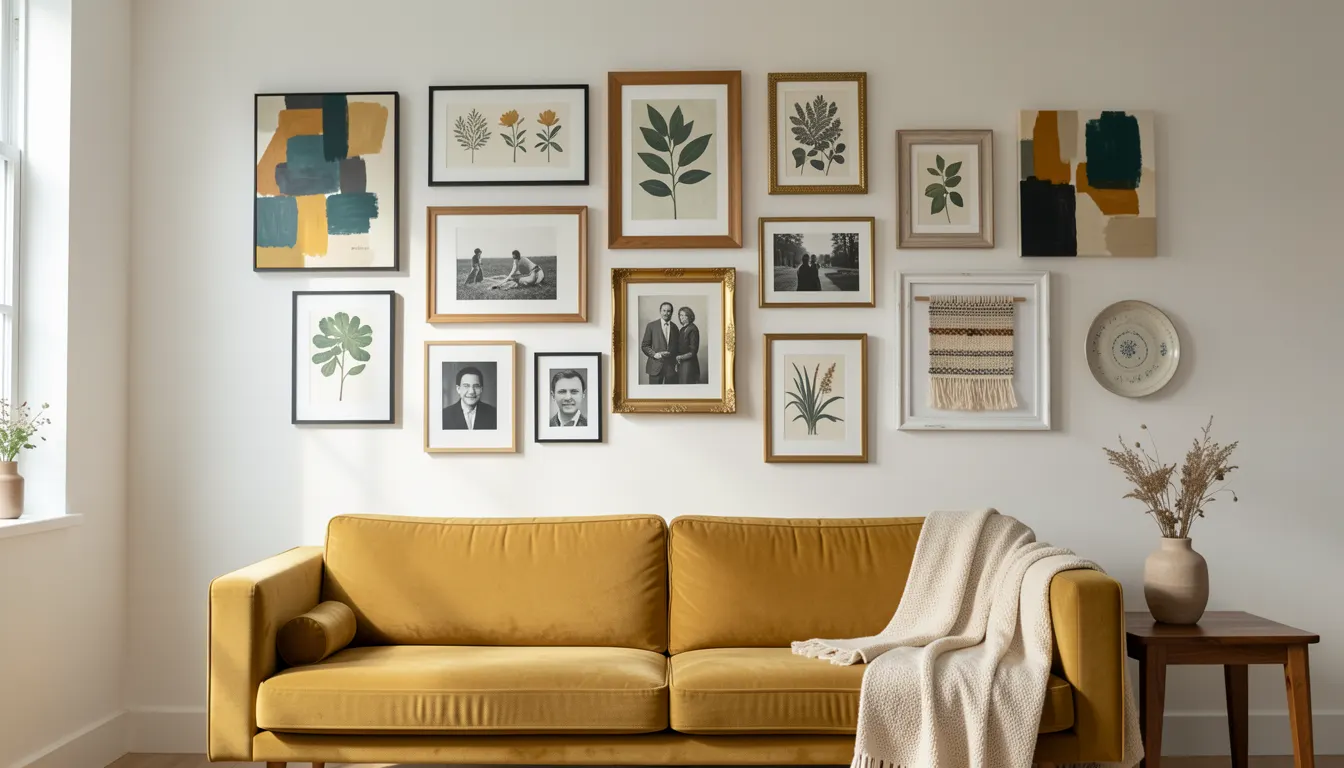
Building an eclectic wall art collection from scratch feels exciting and slightly overwhelming. The style thrives on contrast, old beside new, abstract beside figurative, bold color beside quiet neutrals, but without a guiding logic the result can look chaotic instead of curated. The secret is not matching everything; it is creating threads that tie disparate pieces together. Those threads are usually color, scale, framing rhythm, or a recurring motif. This guide walks through each decision point so you can assemble a collection that looks intentional, personal, and effortless.
Start by defining a unifying color palette, then mix art styles and mediums within that range. Plan layouts on the floor first, use consistent framing or spacing to create harmony, and hang pieces at a shared center height. Add new finds gradually to keep the collection personal and dynamic.
Understanding eclectic style fundamentals
Eclectic decor does not mean random. It means deliberate mixing. A successful eclectic wall relies on a few anchor principles: a limited color story, a consistent hanging height, and a balance of visual weight. Visual weight refers to how much a piece draws the eye, a large dark oil painting carries more weight than a small pale watercolor. Distribute weight across the wall so one side does not feel heavier. Start by gathering images of rooms you love. Notice what repeats: maybe every wall has a touch of brass, or every gallery includes at least one black-and-white photograph. Those repetitions are your future rules.
Why a unifying thread matters
Without a unifying thread, the eye jumps from piece to piece without rest. A thread can be as simple as a single accent color that appears in six different artworks, or a frame finish that repeats across three different styles. It can also be thematic, travel, nature, geometry, but visual threads are easier to control when you are starting from zero. Pick one primary thread and one secondary thread. The primary thread runs through 70 percent of the pieces; the secondary adds surprise.
Common misconceptions
Many people think eclectic means “anything goes.” In practice, the most cohesive eclectic walls follow stricter internal rules than a matched set. Another misconception: you need expensive art. Thrifted frames, printable downloads, children’s drawings, and postcards all belong if they respect your color and scale rules. The frame unifies more than the image inside it.
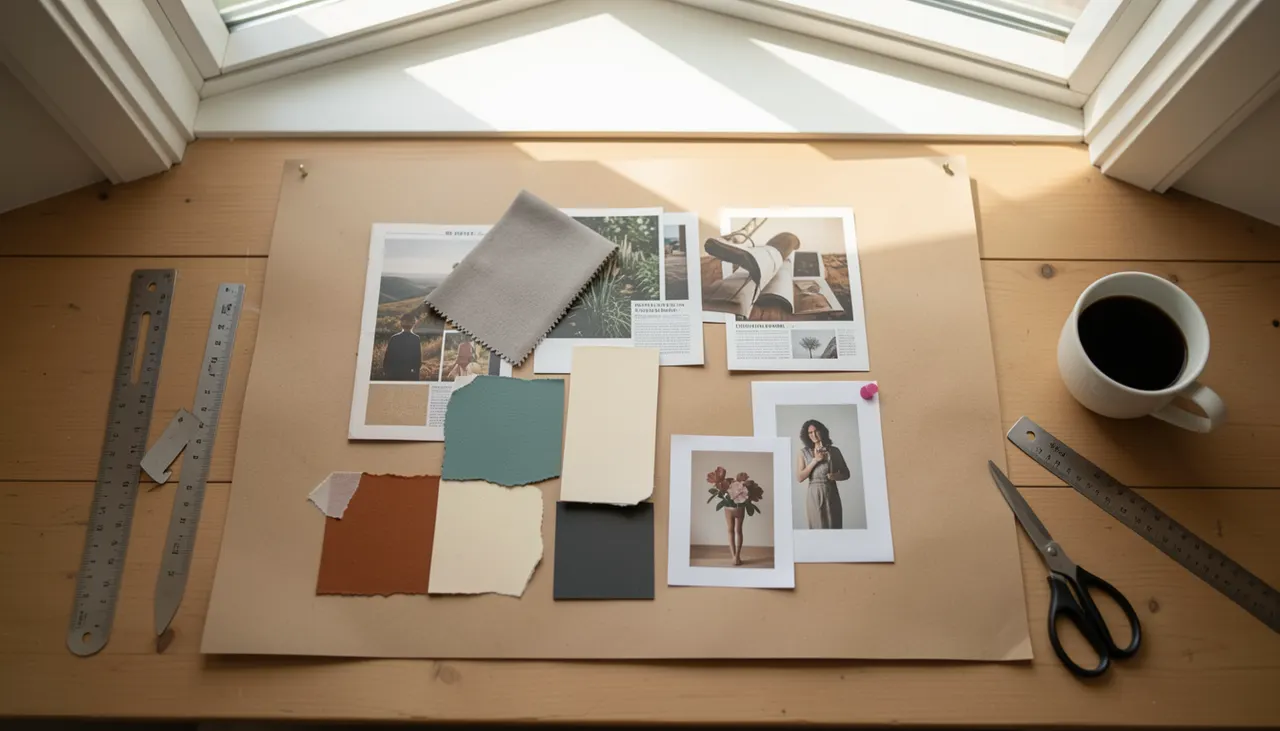
Mood board with color swatches and art clippings
Defining your personal color palette
Color is the fastest way to make unrelated artworks feel like a family. Choose three to five colors total: one dominant, one supporting, two accents, and an optional neutral. Pull these from existing elements in the room, a rug, a sofa, a throw pillow, so the wall converses with the space. If the room is neutral, you have freedom to set the palette entirely from the art. Keep saturation levels consistent; a neon pink will clash with a dusty pastel even if both are technically “pink.” Test by printing small thumbnails of candidate artworks and laying them beside your fabric swatches.
Building the palette step by step
First, identify the dominant color already present in the room’s largest soft furnishing. Second, pick a supporting color from a smaller accent, a vase, a book spine. Third, choose two accent colors that appear in artwork you love but are not yet in the room; these will become the bridge. Fourth, add a neutral (ivory, charcoal, warm gray) for breathing room. Limit yourself to five. More than five fragments the visual story.
Mixing art styles and mediums successfully
An eclectic wall gains depth from variety: paintings, prints, photographs, textiles, objects. The risk is visual noise. Control it by limiting the number of distinct styles to three or four per wall. For example: abstract expressionism, vintage botanical illustration, black-and-white street photography, and a single ceramic piece. That is four styles. Adding pop art, surrealism, and typography would push it to seven, too many. Within each style, vary scale. A large abstract canvas, a medium botanical diptych, three small photographs, one tiny ceramic. The scale variety creates rhythm; the style limit creates coherence.
Medium mix checklist
Include at least one three-dimensional object, a shallow shadow box, a wall-mounted vase, a carved wood panel. Depth breaks the flat plane and catches light differently through the day. Include at least one piece with texture: impasto paint, woven fiber, handmade paper. Texture invites closer looking. Include at least one piece with text or numbers if it fits your theme; typography acts as a visual anchor. Keep the total piece count odd (7, 9, 11, 13) for a natural asymmetrical balance.
Planning your gallery wall layout
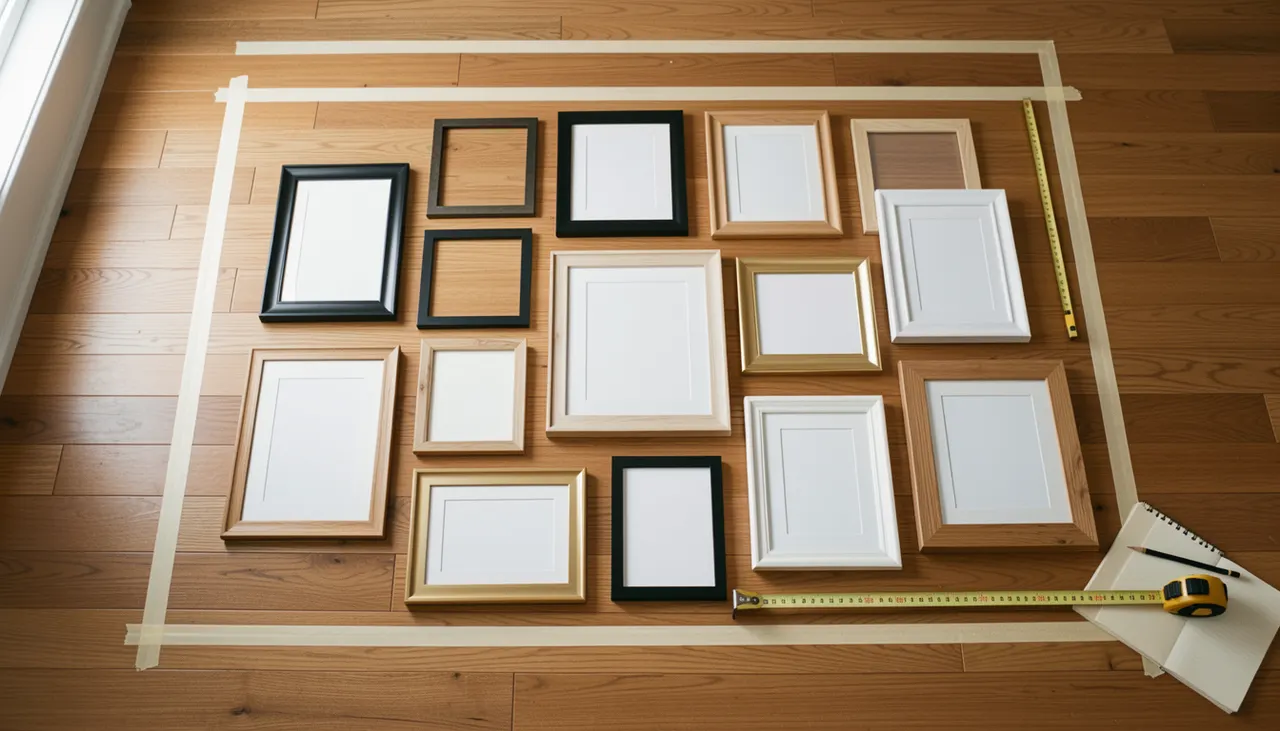
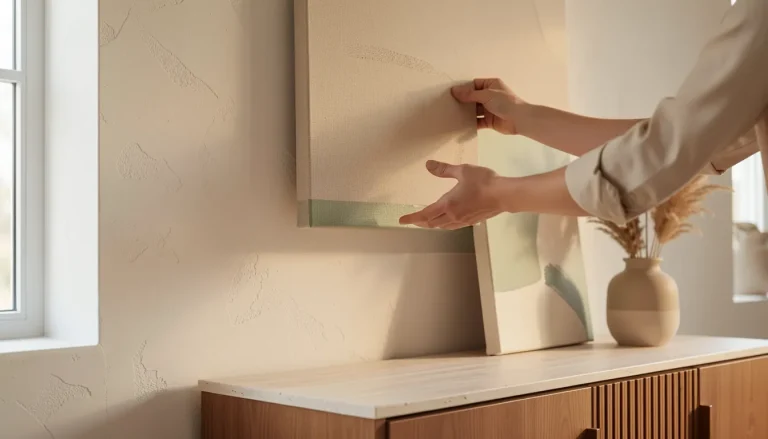
Never hammer a nail before you have a plan. Lay every piece on the floor in the exact arrangement you intend. Measure the total width and height of the composition. Mark the center point. Transfer that center point to the wall at 160 centimeters from the floor, standard eye-level center. From there, measure out each piece’s position relative to the center. Use painter’s tape on the wall to outline each frame’s outer dimensions. Step back. Adjust. Only then drill. This floor-to-wall method prevents the “swiss cheese” effect of extra holes.
Layout archetypes compared
Three common layout structures work well for eclectic collections. Choose one as your primary grammar.
Frames are the visual glue. You have two main strategies: unify by finish or unify by profile. Unifying by finish means every frame is the same material and color, all matte black metal, or all warm oak, regardless of artwork style. This is the safest route for beginners. Unifying by profile means frames share the same depth and molding shape but differ in finish; this is harder to pull off. A third hybrid: two finishes only (e.g., black and gold) applied consistently, all photographs in black, all paintings in gold. Whichever you choose, keep mat widths consistent (typically 5 to 8 centimeters) so the breathing space around each image feels rhythmic.
Hanging techniques for mixed sizes and weights
Eclectic walls mix light paper prints with heavy framed canvases. Use hardware rated for each piece’s weight, not a one-size-fits-all hook. For pieces under 5 kilograms, a single sawtooth hanger or adhesive strip (on smooth walls) works. For 5 to 15 kilograms, use two D-rings with picture wire and two wall hooks spaced 10 centimeters apart, this prevents tilting. Over 15 kilograms, add a third hook or use a French cleat. Always hang from two points on the wall; single-point hanging lets frames shift over time. Use a level on every piece, even small ones.
Evolving your collection over time
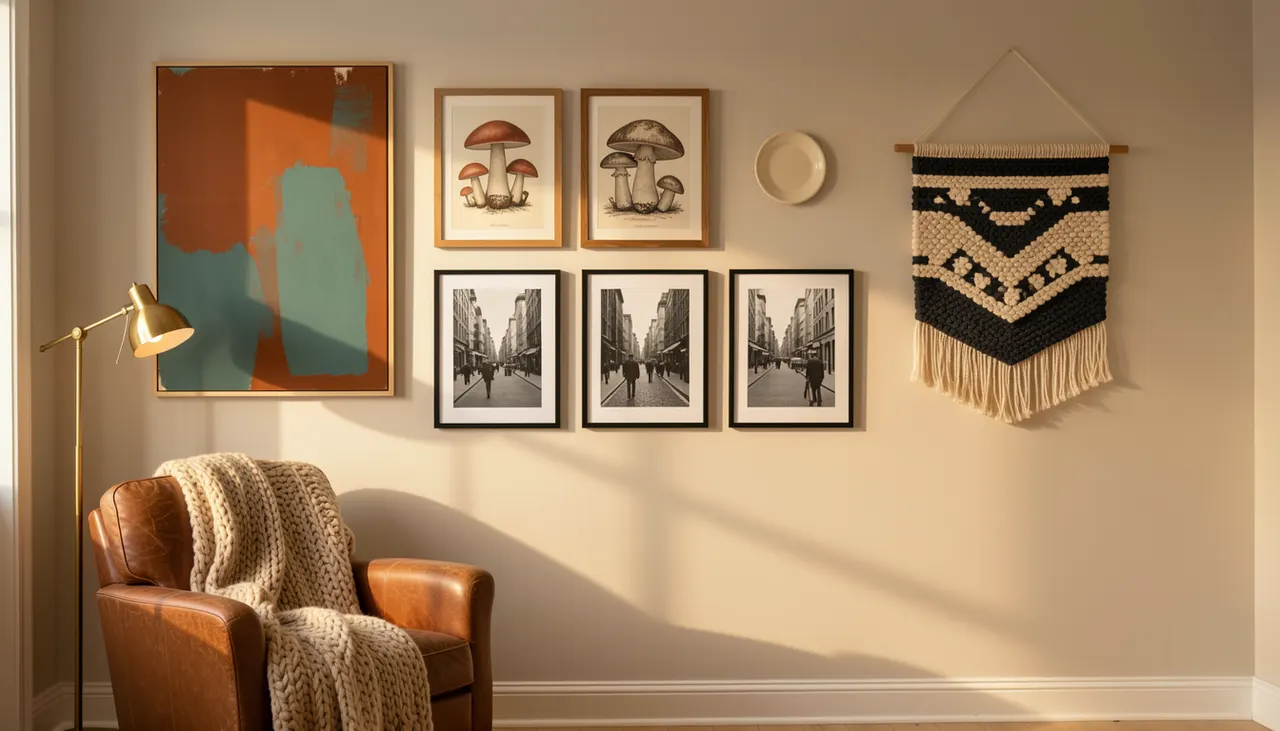
A living collection changes. You travel, you inherit, you discover new artists. Build in flexibility from the start. Leave one or two “open slots” in your layout, empty spaces marked on the wall with faint pencil dots, so new pieces slide in without re-hanging everything. Rotate seasonally: swap three to four pieces each quarter to keep the wall fresh and protect light-sensitive works from fading. Store rotated pieces flat, wrapped in glassine paper, in a climate-controlled closet. Keep a digital inventory: photo, dimensions, frame finish, hanging hardware used, date acquired, and why you chose it. This record helps future decisions and insurance.
Seasonal rotation schedule
Spring: introduce lighter palettes, botanicals, textiles. Summer: add travel photography, found objects, brighter accents. Autumn: bring in deeper tones, abstract landscapes, ceramics. Winter: emphasize contrast, black-and-white, metallic frames. Each rotation touches only 20 percent of the wall. The core 80 percent, your anchor pieces, stays year-round.
When to reframe
Reframe when the frame finish no longer matches your two-finish rule, when the mat has yellowed, or when the glazing reflects too much glare. Upgrading a single frame costs less than replacing the art and instantly refreshes the wall’s cohesion.
Rotated gallery wall with seasonal art changes
Frequently asked questions
How many pieces should I start with for an eclectic gallery wall?
Start with seven to nine pieces. An odd count creates natural asymmetry. You can always add more later, but a smaller curated group lets you test your color and frame rules before committing to a large installation.
Can I mix framed and unframed canvas on the same wall?
Yes, but keep the proportion deliberate. If most pieces are framed, limit unframed canvases to one or two and give them a floating frame or a deep stretcher bar so they have visual weight equal to framed neighbors.
What is the ideal spacing between frames in an eclectic layout?
Keep spacing consistent at 5 to 8 centimeters between outer frame edges. Uniform negative space reads as intentional rhythm; varying gaps make the arrangement look haphazard even if the art is well chosen.
How do I incorporate three-dimensional objects without them looking stuck on?
Mount objects on the same hanging system as framed pieces, D-rings and wire on the back of a shadow box, or a French cleat for heavier ceramics. Align their centers to the same 160 cm line so they share the composition’s spine.
Should all mats be the same color?
Use one mat color for the whole wall, usually warm white or pale gray. Consistent mats act like a visual baseline; differing mat colors fragment the collection more than differing frame finishes.
An eclectic wall art collection is never truly finished, it grows with you. The framework you build now (palette, frame rule, center line, layout grammar) makes every future addition easier and every rotation feel like a refresh instead of a rebuild. Start with seven pieces you genuinely love, hang them using the two-hook method, and live with the result for a week. You will see where the next piece belongs before you even find it.
Key takeaways
Limit your color palette to five hues pulled from the room’s existing textiles and furnishings.
Choose three to four art styles maximum per wall; vary scale within each style.
Lay out the full arrangement on the floor before drilling any holes.
Unify frames by one or two finishes only; keep mat widths consistent at 5 to 8 centimeters.
Hang every piece from two wall hooks aligned to a 160 cm center line for stability and cohesion.
Partager sur :
Laure D
Passionate about interior design and architecture, Laure D. is the inspiring voice behind Museno. As a decor trends specialist, she elegantly decodes color harmonies, the art of detail, and space planning to transform every interior into a unique sanctuary. Through her articles and guides, Laure shares expert advice and inspiration to help you elevate your daily life, from contemporary minimalism to bolder aesthetics. Her mission: to bring life to your rooms and walls with inspiring, accessible ideas.